Testing a stack design through summer and winter
Atkinson Science used VU.CITY's 3D model of the Edgbaston Campus to check that two gas stacks would stay safe as the trees around them changed with the seasons.
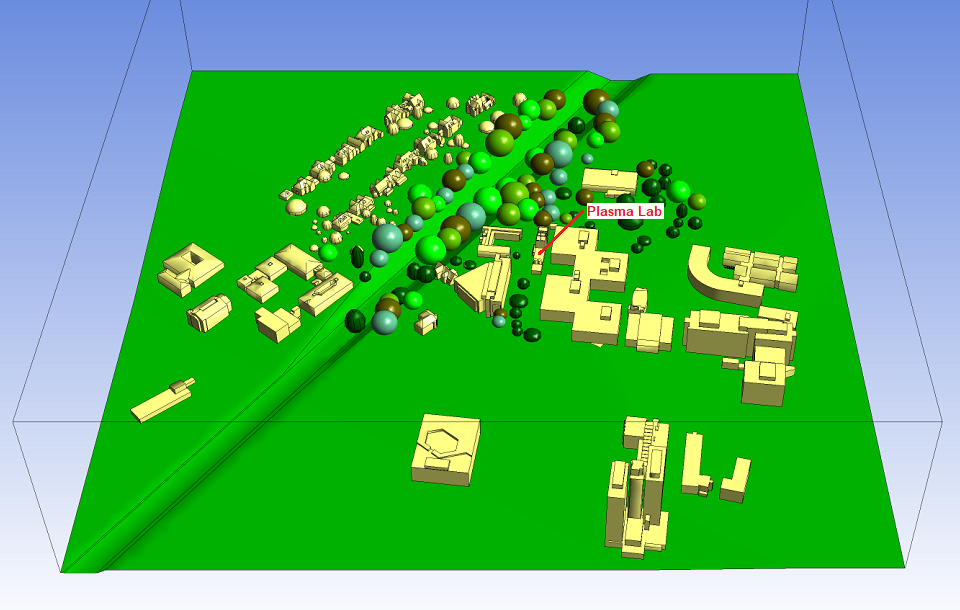
The University of Birmingham is refurbishing the Plasma Laboratory in the northwest corner of its Edgbaston Campus. The laboratory's southern tower will have four rooftop stacks arranged around a supporting mast. At the time of the study, two were planned to be active. One will release pure hydrogen at 200°C and the other pure nitrogen at 20°C. Both gases must disperse safely without putting people in other buildings or on the ground at risk.
What was being tested
Hydrogen can burn when it makes up between 4% and 75% of the air. To stay below that lower limit, the hydrogen leaving the stack must be diluted at least 346 times before it reaches a building or the ground. Nitrogen brings a different risk. Air with less than 19.5% oxygen is dangerous to breathe, so the nitrogen must be diluted at least 14.9 times.
How the model was built
Atkinson Science built a CFD model centred on the laboratory, covering 600 m by 600 m of buildings and landscape. VU.CITY supplied the geometry of the surrounding buildings. Atkinson Science simplified the terrain and represented the trees themselves.
A dense stand of trees sits to the northwest of the laboratory. In summer their leaves shelter the building from northwest winds, and in winter they offer very little shelter. So Atkinson Science modelled the tree canopies as simple shapes for summer and removed them for winter.
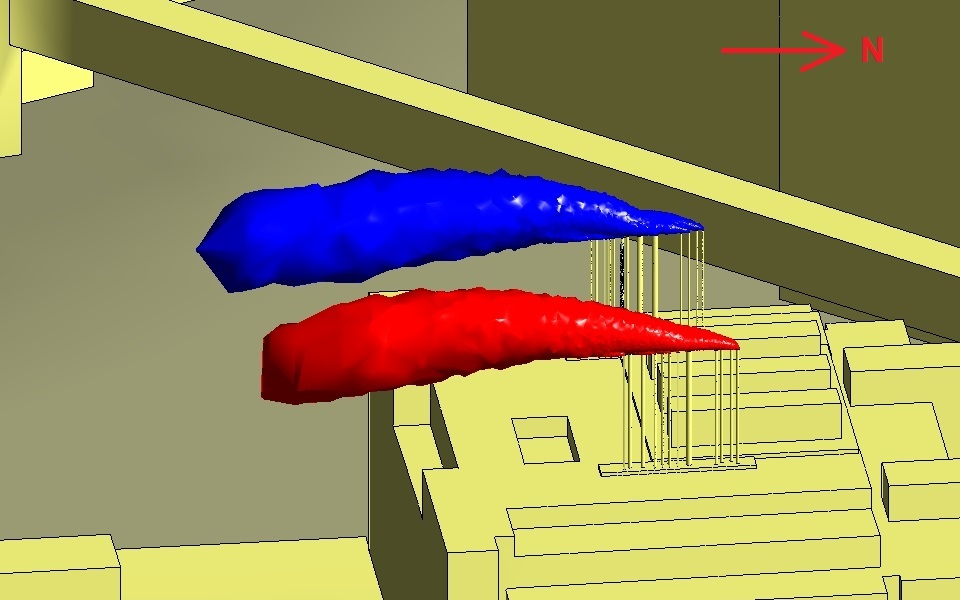
Using Met Office data, they ran 24 summer simulations at 0.25, 2.5 and 10 m/s from every 45°, and 9 winter simulations for winds from the north, northwest and west. For each one they plotted where the gases had been diluted 1,000 times, well beyond what safety required.
What they found
In summer, with a strong northerly wind, air flowing down off the trees pushed both plumes along a path about 10° below horizontal. In winter, without the canopies, the plumes stayed level. The hydrogen dispersed much faster than the nitrogen, because it is far lighter and leaves the stack with much less upward momentum.
Across all 33 simulations, none of the plumes touched a building or the ground. The study showed the university that the stacks would perform safely in the wind conditions expected on campus.
Read the full case study, with all of Atkinson Science's CFD images, on their website.
Need the buildings around your site for a CFD or environmental study?
VU.CITY provides accurate 3D geometry of the surrounding city, so your model starts with the real context.





.svg)

.svg)
.svg)
.svg)

.svg)
.svg)


.svg)


.svg)
.svg)
.svg)

.svg)


.svg)
.svg)